
Jessop & Appleby steam crane model
One of Hobart’s most recognisable waterfront landmarks has been recreated in miniature for Hobart: Port City, a major new long-term exhibition at Maritime Museum Tasmania.
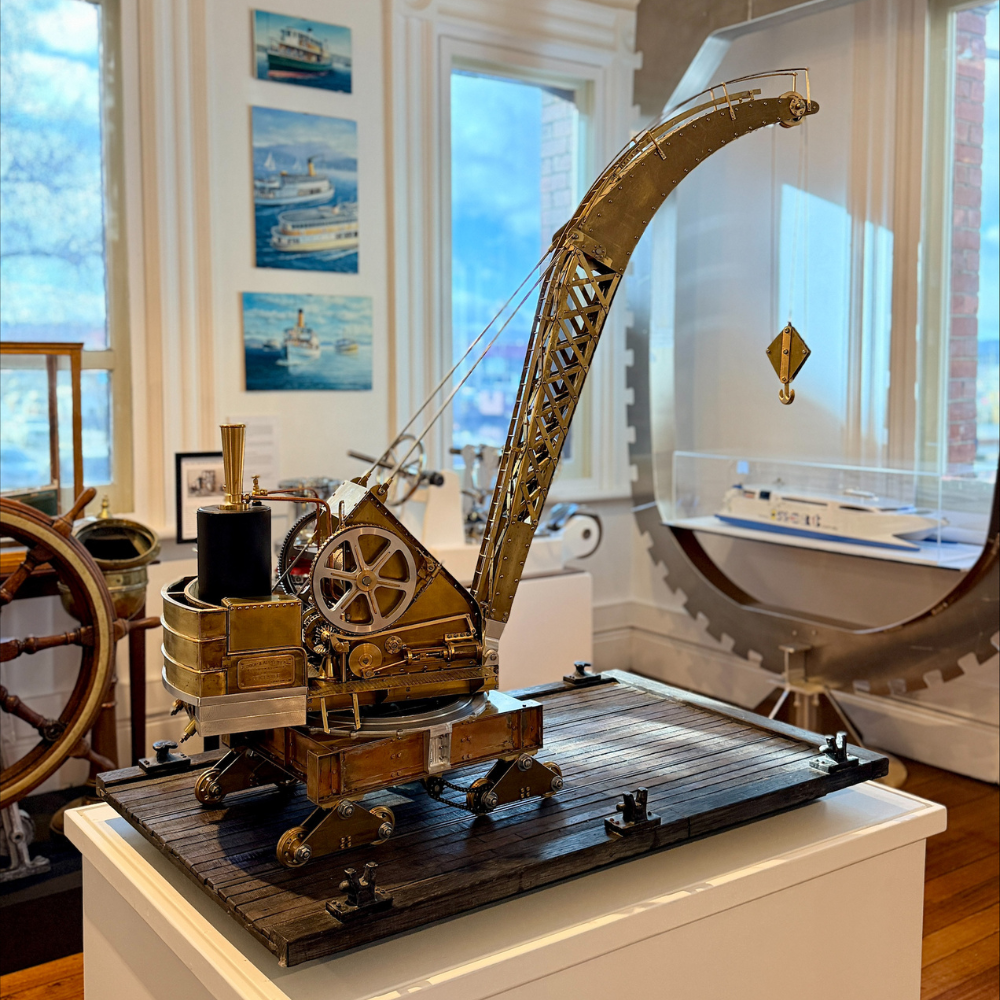
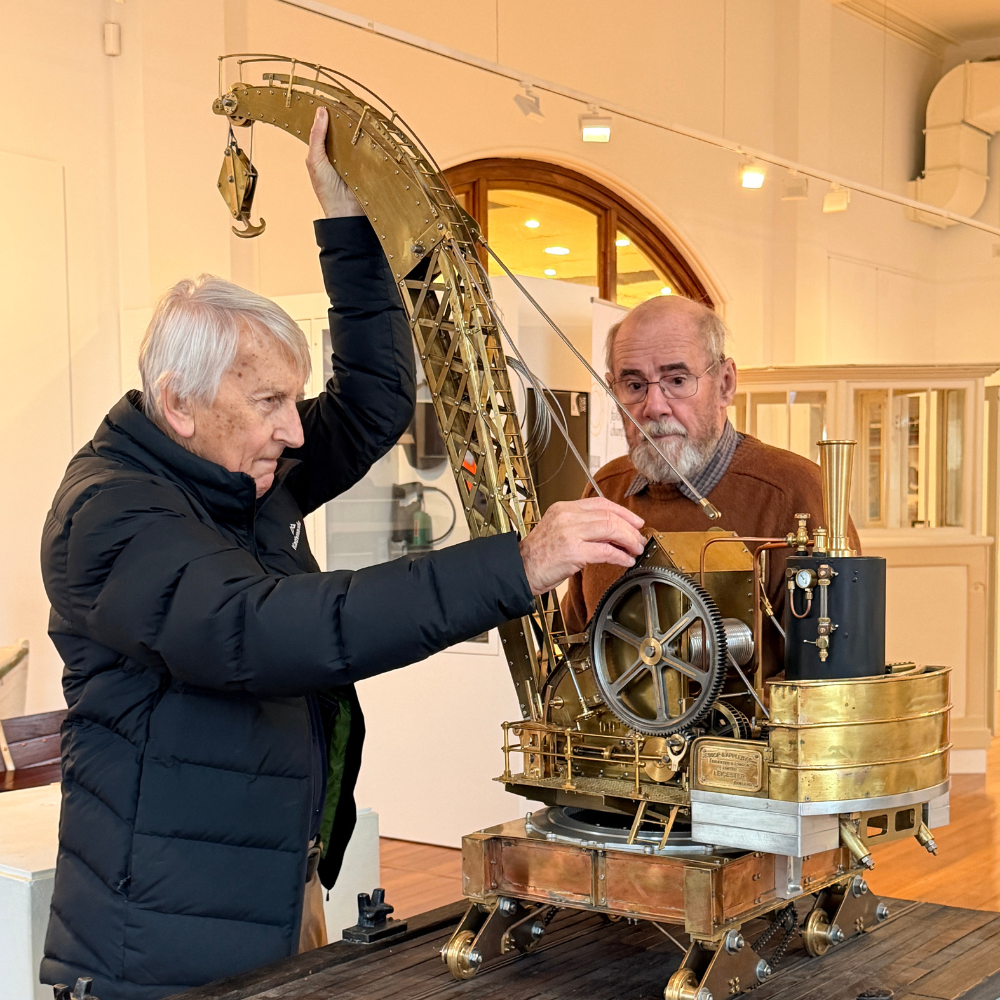
Dr Tony Sprent AM has donated his detailed hand-crafted model of the historic Jessop & Appleby steam crane, which has stood near Constitution Dock for more than a century.
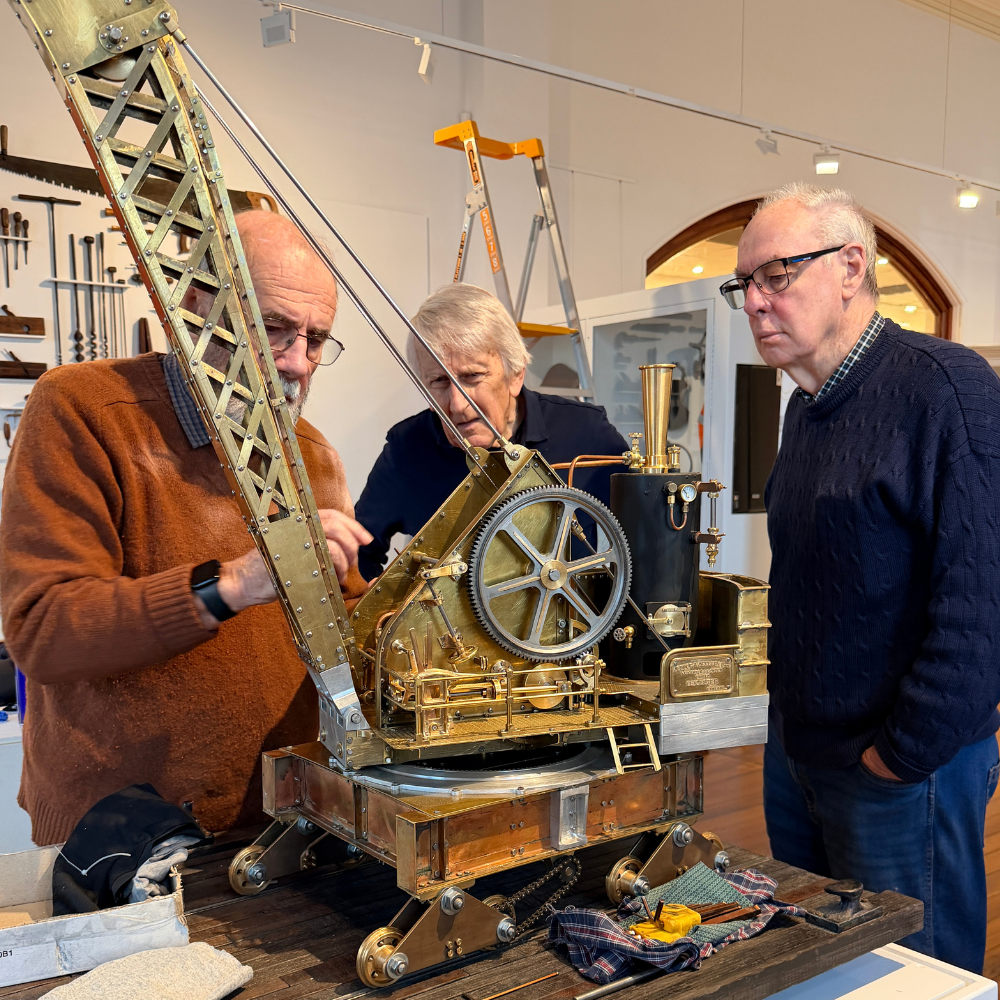
Built at a scale of 1:12.7, equivalent to 2 mm on the model for every inch on the original crane, the model provides a rare view of the engineering normally hidden inside the full-sized structure. Its boiler, steam engine, lifting equipment, wire ropes, chains, sprockets and complex system of gears have all been carefully reproduced.
The model will become one of the centrepieces of Hobart: Port City, an exhibition exploring the development of Hobart’s working waterfront and its importance to the growth of the city.
Through significant objects, photographs, maps, artworks and personal stories, the exhibition will examine the buildings, businesses, vessels and people that shaped Sullivans Cove and the wider port.
Revealing the machinery within
The surviving crane remains a familiar feature of Hobart’s waterfront, but its enclosed machinery and working systems are difficult to appreciate from the outside.
Dr Sprent constructed the model following years of research into the crane’s design, construction and operation.
Using original drawings, historical photographs and measurements taken from the full-sized crane, he worked to reproduce both its distinctive appearance and its complicated internal machinery.
“I have been interested in the crane for many years, both as a piece of engineering and as an object with great visual character,” Dr Sprent said.
“I am delighted it will be displayed at the Museum and become part of the story of Hobart’s working waterfront.”
A modern crane for a growing port
The Marine Board of Hobart ordered the travelling steam crane in 1897 as the port expanded to handle larger ships and heavier cargo.
Manufactured by Jessop & Appleby in Leicester, England, the crane arrived in Hobart in May 1899. It was erected on Dunn Street Pier, which had to be strengthened to carry its considerable weight. Contemporary reports described the new machine as one of the most modern and complete cranes in the Australian colonies.
The crane weighed approximately 85 tons and was guaranteed to lift 25 tons at a fixed radius of 30 feet, or about 9.1 metres. It travelled along 216 feet, approximately 66 metres, of rails laid along the pier.
Its features included wire lifting rope rather than chain, a hook mounted on ball bearings so that suspended loads could be rotated, and controls arranged so that the machinery could be operated by a single engineer.
Steam generated in the crane’s boiler powered an engine within the revolving upper structure. Through its system of gears, drums, sprockets and ropes, the engine could raise and lower cargo, rotate the crane and move the entire machine along its rails.
Almost 70 years of service
When Kings Pier replaced Dunn Street Pier in 1910, the crane was transferred to the new structure. It could travel along the full length of the pier’s southern side, although it appears to have spent much of its later working life near the city end, where it was used for heavy lifting and ship repairs.
The crane remained available for port work into the late 1960s. In July 1969, it was called upon to assist the cargo ship Warwickshire after the vessel experienced problems with its own lifting equipment while berthed at South Kings Pier. The crane ceased operating shortly afterwards.
Now decommissioned, the full-sized crane rests on timber supports near Constitution Dock. Its survival provides a direct physical connection with the period when Hobart’s finger piers were busy with cargo vessels, waterfront workers, railway wagons and steam-powered machinery.
About Dr Tony Sprent AM
Dr Tony Sprent taught spatial science at the University of Tasmania for 35 years. During his career, he designed and constructed precision measuring equipment used in spatial science and astronomical research.
He was appointed a Member of the Order of Australia in 2011 for service to spatial science and astronomy, and for developing technical equipment to assist people with disability.
His Jessop & Appleby crane model combines detailed historical research with the precision engineering skills developed throughout his professional career.


Hobart: Port City

